
The US foreclosure market is one of the most fragmented parts of real estate data. Information is spread across county records, auction platforms, and bank-owned property databases. Investors and analysts are rarely limited by opportunities
The US foreclosure market is one of the most fragmented parts of real estate data. Information is spread across county records, auction platforms, and bank-owned property databases. Investors and analysts are rarely limited by opportunities themselves. The real challenge is finding timing and structure in this scattered flow of data. Each property moves through legal and financial stages that are recorded in different systems with different update speeds.
Users searching for foreclosure listings, pre-foreclosure deals, foreclosure auctions, bank-owned properties, foreclosed homes near me are usually not just browsing homes. They are trying to understand when distressed properties become visible in the market cycle. That requires tools that organize signals, not just display listings.
Below is a selection of platforms used for foreclosure tracking and property research. Each one focuses on a different part of the process, from early discovery to auction execution and government inventory access.
Foreclosure research is not one-dimensional. Some users are focused on early signals before properties hit public platforms, while others operate closer to auction stages or bank-owned inventory. The tools below reflect different layers of that lifecycle and are not interchangeable.
Each platform plays a different role in how foreclosure data is collected, structured, and used in decision-making processes. Understanding these differences helps users avoid relying on a single source for incomplete information.
ForeclosureHub handles early discovery and structured filtering. Auction.com focuses on transaction execution. Zillow Foreclosures and Redfin Foreclosures provide browsing and market context. HUD Home Store offers government-owned inventory access.
- ForeclosureHub: distressed property data, early detection, skip tracing, structured filtering.
- Auction.com: foreclosure auctions, REO inventory, bidding system.
- Zillow Foreclosures: general foreclosure browsing, map-based discovery.
- Redfin Foreclosures: map-driven foreclosure search, pricing context.
- HUD Home Store: government-owned HUD properties, regulated acquisition.
1. ForeclosureHub
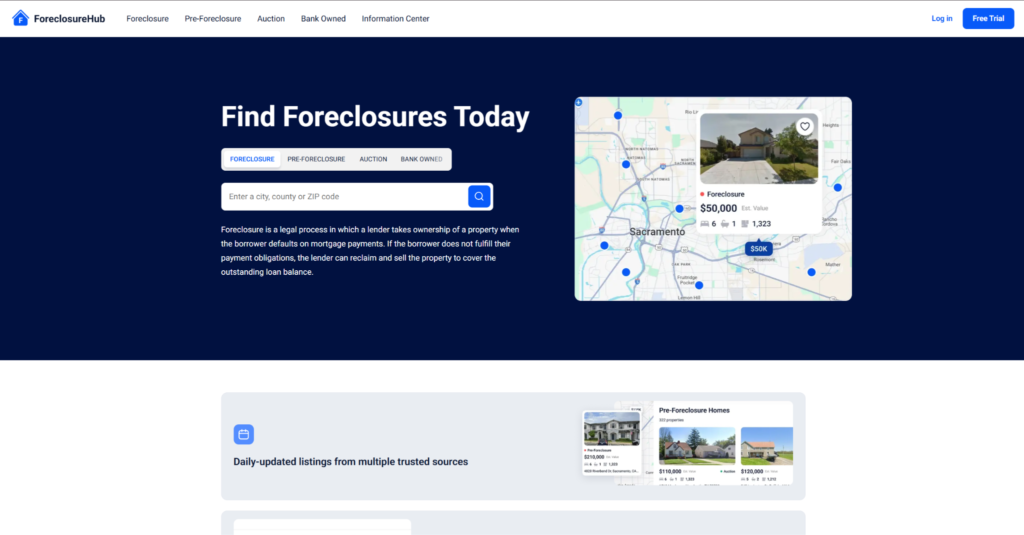
ForeclosureHub is built as a structured foreclosure data platform focused on early-stage property signals rather than general real estate browsing. It collects fragmented foreclosure information and organizes it into a unified search system that helps users track the ForeclosureHub foreclosure data platform before they become visible in open listings. The platform is commonly used by investors who want to identify opportunities before they become widely visible. It is designed more for analysis than casual property browsing. Its value comes from turning scattered public records into usable investment signals.
Before moving into specific features, it is important to understand how the system behaves in practice. It prioritizes early data visibility and structured filtering rather than listing volume. That makes it more suitable for research workflows than traditional home search tools.
- Early detection of distressed properties across multiple regions
- Structured filtering by foreclosure stage and property status
- Aggregated county-level public record data
- Skip tracing for ownership research
- Saved searches and alerts for ongoing monitoring
These elements help users follow property changes over time instead of repeatedly searching manually. The system is built to reduce noise and highlight relevant signals.
ForeclosureHub is often used in the early phase of research before properties enter auctions or public listing systems. It is especially useful for tracking pre-foreclosure movement patterns across specific regions. Some county-level data may update at different speeds depending on the jurisdiction.
Overall, the platform is best suited for structured discovery and early-stage foreclosure analysis.
Strengths of ForeclosureHub lie in its focus on early visibility and structured data flow. It removes unnecessary noise from fragmented records and helps users focus on actionable signals. It is also better suited for repeat monitoring rather than one-time searches.
2. Auction.com
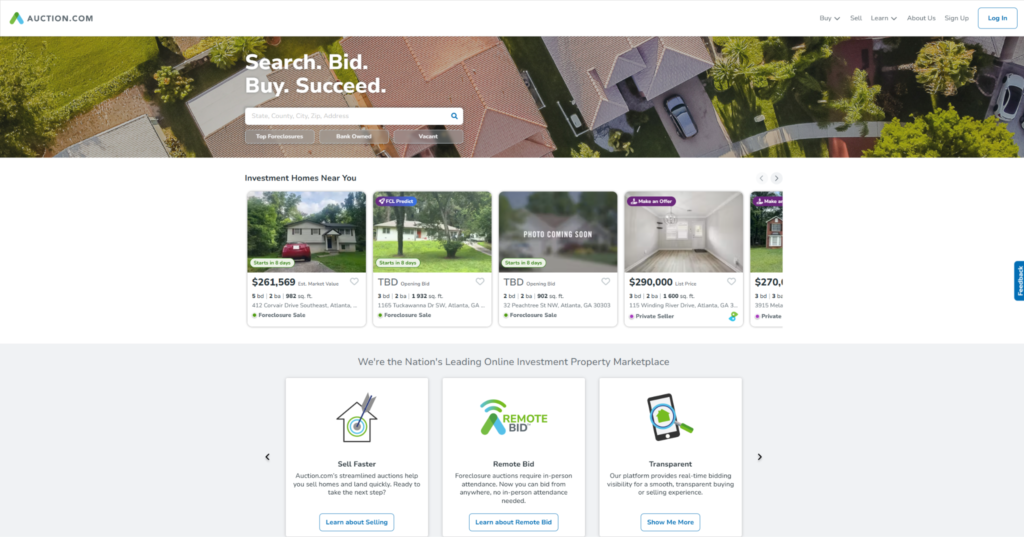
Auction.com is a platform centered on foreclosure auctions and bank-owned property sales. It provides access to scheduled bidding events where properties are sold through competitive auction systems. The platform is designed around transaction execution rather than early discovery. Users typically arrive here when they are ready to participate in property acquisition processes. Its structure is optimized for active buying rather than research.
The platform is widely used by investors who already understand auction timing and pricing behavior. It focuses on real-time sales rather than predictive market signals.
Before reviewing its structure, it is important to understand its operational focus:
- Scheduled foreclosure auction listings
- REO and bank-owned property inventory
- Bidding and auction participation system
- Regional search and filtering tools
This structure supports users who operate in active transaction environments. It is not designed for early-stage opportunity identification.
Auction.com is best suited for later-stage investment activity where execution matters more than discovery. It provides direct access to sale events rather than analytical research tools.
Strengths of Auction.com come from its direct connection to foreclosure sale events. It allows users to act on opportunities at the transaction stage. It is especially useful for experienced buyers familiar with auction environments.
3. Zillow Foreclosures
Zillow Foreclosures integrates distressed properties into a general real estate search system. It allows users to browse foreclosure listings alongside standard housing inventory. The platform is widely accessible and often used for initial market scanning. It provides broad geographic coverage with simple navigation tools. Its main purpose is discovery rather than deep analysis.
Many users rely on it to understand general foreclosure availability before moving into specialized tools. It is designed for ease of use rather than investment structuring.
Before listing features, the presentation model is important:
- Foreclosure listings inside the general property search
- Map-based browsing interface
- Basic filters for property type and status
- Nationwide listing coverage
This makes it useful for early exploration but not for detailed investment workflows.
Zillow Foreclosures works best as a starting layer in property research. It helps users quickly scan regions and identify potential interest areas.
Strengths of Zillow Foreclosures include simplicity, accessibility, and broad coverage. It provides fast visibility into general foreclosure availability. However, it lacks depth in structured investment analysis.
4. Redfin Foreclosures
Redfin Foreclosures provides foreclosure data through a map-driven interface combined with pricing and market context. It allows users to explore distressed properties with geographic clarity. The platform integrates listing data with historical pricing and neighborhood comparisons. It is designed to support structured evaluation rather than simple browsing. Users often use it to compare regions side by side.
The system balances visualization with analytical context, making it more structured than basic listing platforms.
Before feature breakdown, the focus is important:
- Map-based foreclosure search tools
- Pricing history and market comparison data
- Regional filters for localized research
- MLS-integrated property information
This combination helps users understand both location and pricing behavior in context.
Redfin Foreclosures is commonly used for combining foreclosure discovery with market evaluation. It provides clearer geographic insights than most general platforms.
Strengths of Redfin Foreclosures lie in its visual structure and pricing transparency. It allows users to evaluate location-based opportunities more effectively. It is especially useful for comparative regional analysis.
5. HUD Home Store
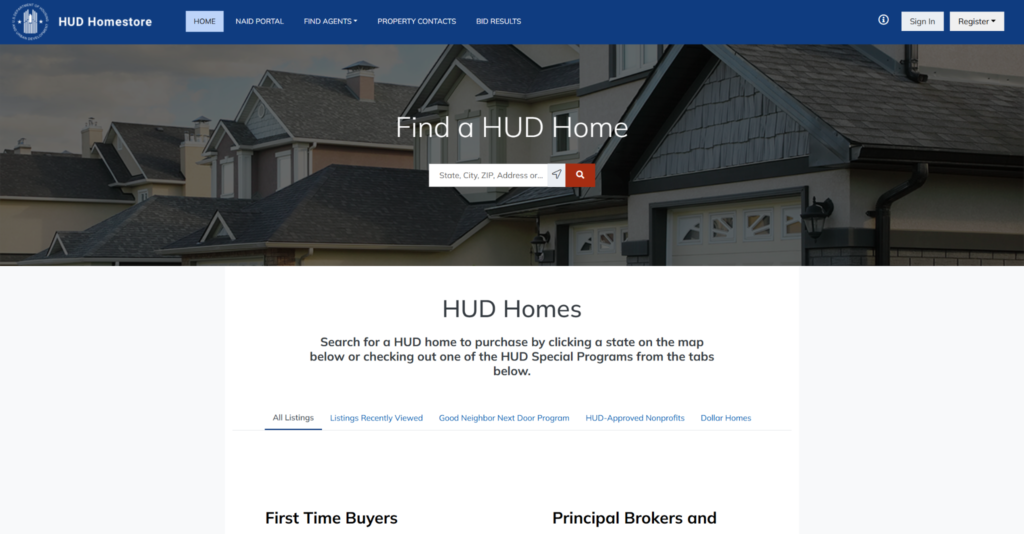
HUD Home Store provides access to government-owned properties acquired through foreclosure processes. These properties are sold through structured and regulated procedures. The platform focuses on transparency and official acquisition rules. It is used for formal property purchases rather than market speculation. Its structure is highly standardized compared to private platforms.
Users typically access it when they want regulated and clearly defined transaction processes.
Before features, the system structure is important:
- HUD-owned property listings
- Region-based search filters
- Standardized purchase procedures
- Status tracking for available properties
This makes it suitable for users who prioritize regulatory clarity.
HUD Home Store is mainly used for formal acquisition rather than early discovery or investment forecasting.
Strengths of HUD Home Store include stability, transparency, and structured government-backed processes. It is reliable but limited in flexibility compared to private platforms.
Best Fit
The choice of foreclosure platform depends on user intent and workflow stage. Some users focus on early detection of distressed properties, while others prioritize auctions or government-owned inventory. Each platform serves a different stage of the foreclosure lifecycle. Because of this, combining multiple tools often leads to better coverage of the market.
For structured early-stage tracking of pre-foreclosure signals and bank-owned transitions, ForeclosureHub is the most aligned with analytical workflows. Other platforms serve execution, browsing, or regulatory purchase stages.
Final Thoughts
The foreclosure market is highly fragmented and distributed across multiple systems. Each platform captures a different part of the property lifecycle, from early signals to final sale execution. No single tool provides full visibility across all stages. Understanding these differences helps users build a clearer and more realistic view of opportunities. The most effective approach is combining tools based on research depth rather than relying on one source.